


Growing for the Future
Certis Belchim’s ongoing ambition is to provide integrated programmes, combining biorational and chemical products, that meet the challenges of sustainable crop production and the demands of the supply chain.
Working with researchers, growers and agronomists our trials aim to demonstrate that you can work towards a reduced residue programme, without sacrificing quality and yield.
Strawberry Powdery Mildew
So far, our G4TF initiative has focussed on powdery mildew, in June-bearer strawberry crops. Trials have tested timing and efficacy of biorational solutions, as well as programmed approaches to controlling this common, but economically challenging, disease.
Key findings from G4TF 2025
- Leaf powdery mildew infection in the G4TF programmes was not significantly different from the conventional programme
- G4TF programmes had higher yields compared to the conventional programme
- There was no significant difference in fruit quality between G4TF and conventional

What’s Next?
In 2026 we will host our final G4TF strawberry trials. We are running G4TF programmes in vines and will continue to expand the initiative into other crops, including field vegetables.
G4TF NEWS

- Resistance management is easier with Takumi
- Preventative and curative
- Great beneficial profile

Mode of Action
Takumi’s unique MOA, in addition to its vapour activity, helps give persistent control of powdery mildew. It’s preventative, curative and, thanks to a good beneficial profile, IPM compatible. With an EAMU for strawberries (20552016), Takumi has a short PHI of just three days. Takumi is crop-safe, easy to use and rainfast in one hour.

Takumi offers penetrant and translaminar activity with additional vapour properties at higher temperatures. The active, cyflufenamid, is unique to its FRAC group (U6) giving greater flexibility to alternate or combine Takumi with products that use different modes of action, such as Karma.
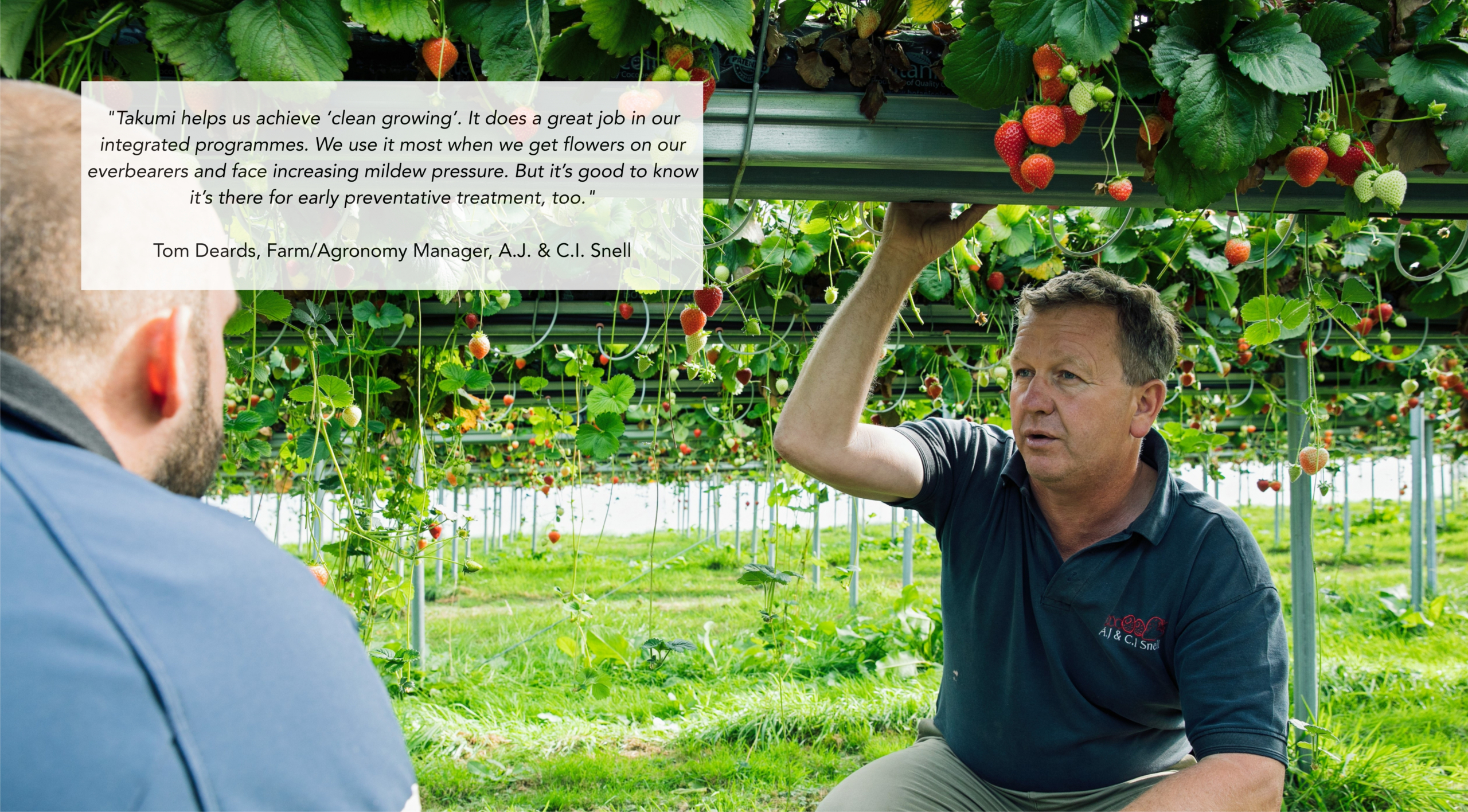

Our G4TF programmes position Takumi early in the programme for preventative control of powdery mildew and later to protect green fruit and developing flowers facing increasing mildew pressure.


- Formulated for crop safety
- Adjuvants improve crop safety
- Preventative, curative and eradicant

Mode of Action
A contact eradicant, Karma is ideal for IPM programmes and has just a one-day PHI. It’s based on potassium hydrogen carbonate (an approved food additive), so there are no residues or MRLs to worry about.
Karma inhibits mycelial growth and causes total collapse of spores. What’s more, it helps prevent infection by disrupting the release of hydrolytic enzymes used by fungi to infect plants.
In addition, powerful built-in surfactants promote efficacy, coverage and rain-fastness.

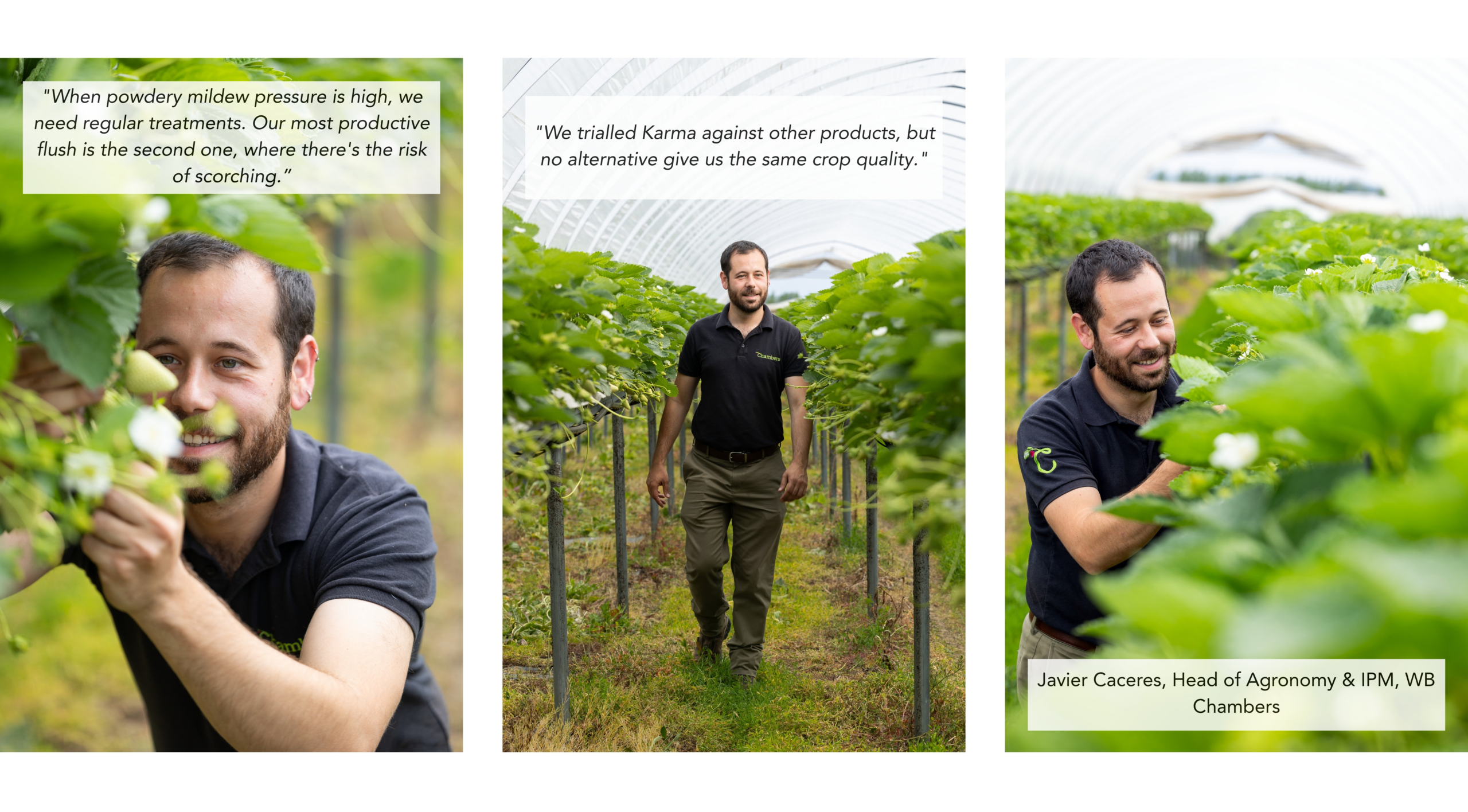
Our G4TF programmes embrace the curative and eradicant properties of Karma throughout the programme. Where pressure is high, tank–mix Karma for its spreading properties and for additional contact control of surface pathogens.


- Preventative botrytis and powdery mildew control
- Residue free
- Primes the plant for resilience against future infection

Mode of Action
Amylo-X contains Bacillus amyloliquefaciens subsp. plantarum strain D747 which has three key modes of action from foliar application:
- Antimicrobial lipopeptides destroy fungi & bacteria
- lipopeptides are already in formulated product
- they are also produced when spores germinate on application
- Competition and exclusion of pathogens on the surface
- Systemic acquired resistance
Multiple modes of action make Amylo-X ideal for alternation with other Botrytis and powdery mildew products.
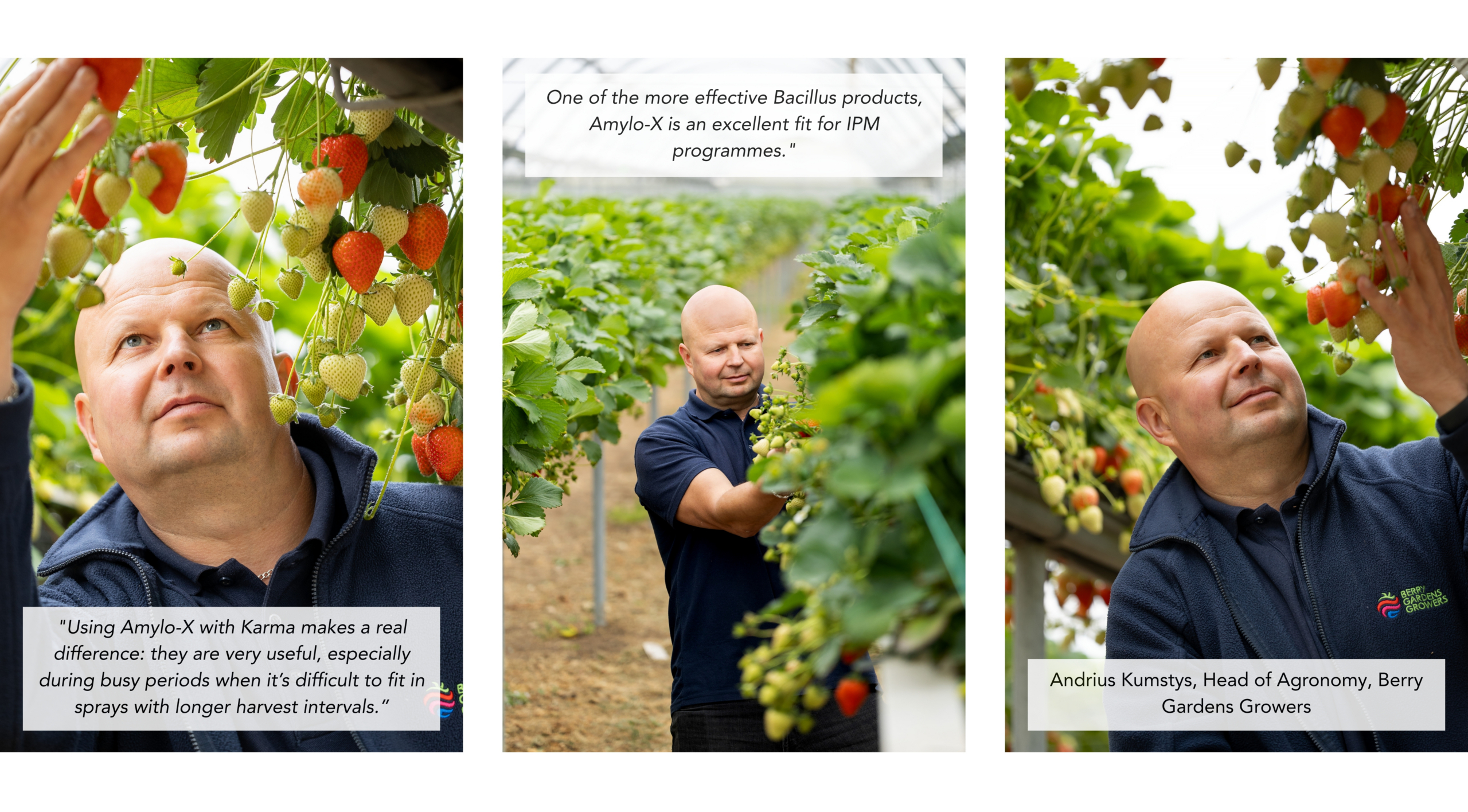
Our G4TF programmes apply Amylo-X in block treatments throughout flowering and fruiting stages of strawberries, up to BBCH 89.


IPM takes centre stage in UK horticulture
Integrated approaches combining conventional plant protection products, biorationals and biostimulants are moving from theory into practice. In the first of a three-part series, Fruit Grower finds out how.
UK horticulture is going through a period of significant change.
Growers are facing increasing pressure on multiple fronts, from tight retailer specifications on residues, to the continued loss of active substances and the never-ending challenge of managing resistance in target pests and pathogens.
At the same time, more variable climatic conditions are adding complexity, making it harder to rely on familiar approaches to crop protection.
Against this backdrop, attention is shifting to how different tools can be combined more effectively, rather than the replacement of conventional chemistry outright.
That shift is already evident at a global level. Growers are successfully moving towards integrated programmes that bring together conventional crop protection, biorationals and, increasingly, biostimulants.
Biorational market
For Dennis Eekhoff, global project manager for biorationals at Certis Belchim, the wider crop Protection industry is still in a transitional phase.
“There is growth in the biorational market, but a lot of the products we see today are all quite similar – largely microbial products.”
“They work well in protected crops, where you can manage the environment, timing and carry out repeated applications, but in field conditions, the performance is not always strong enough.”
That gap between potential and practical performance is shaping the next wave of innovation.
Certis Belchim, for example, is increasingly looking beyond traditional microbials to targeted technologies, including peptides and RNA-based products.
These could offer improved efficacy within the plant, like that of conventional chemistry.We don’t want to mention this, it is our secret where we searching for, we don’t want to help our competitor.
“In outdoor crops, that’s what growers need. If you spray, you want the product to move into the leaf and protect new growth; that is where the next generation of biorationals might make a difference.”
Shifting regulation
But technical progress alone is not enough and regulatory frameworks – particularly in Europe – remain a significant barrier to bringing new solutions to market.
While registrationcan reach in one to two years in Brazil or the US, the European system can take much longer, often up to 10 years.
“You can spend five or six years on a active ingredient approval, and then another two to three years for country-level product registration,” explains Dennis.
“That creates a situation where the costs are high, but many biorational products are very specific – only active against one pest or disease – so the commercial return is more limited, slowing innovation.”
Dennis adds that despite these challenges, the biorational product development direction is keeping growing and developing,
“It’s about combining approaches. If you can mix or alternate biorationals with conventional products, you can improve resistance management and lower residues, all while maintaining efficacy.”
Integrated thinking
That observation is echoed by his colleague Pedro Cabanita, Certis Belchin’s global portfolio manager for biostimulants and integrated programmes.
He argues that the industry is moving towards a more holistic understanding of plant health, where crop protection, nutrition and stress management are linked.
“We are no longer looking only at plant protection products in isolation. We are looking at the overall resilience of the plant.”
Biostimulants are playing a growing role in that shift, not as replacements for pesticides but as tools to support plant performance under stress.
“If a plant is under abiotic stress – from drought, heat or other factors – it becomes more vulnerable to pests and diseases. Biostimulants help the plant cope better,” he notes.
That is one of the key drivers behind the rapid growth of the biostimulant market, which is expanding at around 10% annually, according to industry estimates.
Climate variability
Crucially, Dennis and Pedro stress these tools are most effective when used proactively.
“With a conventional product, you often react to a problem,” explains Pedro. “With biostimulants and many biorationals, you are investing before the problem occurs.”
That shift in timing – and mindset – is one of the biggest challenges for growers, he believes.
“You must prove the return on investment. Farmers need to see that consistently over time, these programmes help maintain their yields, quality and profits.”
Evidence suggests that, when used correctly, integrated programmes can deliver comparable levels of crop protection while offering additional benefits in resilience, residue management and long-term sustainability.
But both emphasise it is not about replacing everything overnight. It’s about building programmes step by step, using all the tools available.
UK focus
For Libby Rowland, Certis Belchim UK horticulture crop manager, the challenge moves from theory to practice, making integrated programmes work in the field, polytunnel or orchard.
She says biorationals are being positioned less as replacements for conventional chemistry and more as tools within programmes to help extend control windows, reduce residue loading and support resistance management.
In the UK this is already most advanced in soft fruit, particularly strawberries, where extended harvest windows and sustained disease pressure expose the limitations of conventional-only approaches.
“In longer-season crops, you quickly run out of options. Integrating biorationals gives more room to manoeuvre, both from a resistance and a residue perspective.”
However, successful use depends on a shift in mindset as many biorationals require precise timing, optimal application and a more preventative approach.
“Coverage, timing and conditions all matter more. It is not necessarily more complicated, but it is different, and growers need confidence that it will deliver.”
Concept to practice
This confidence is what Certis Belchim’s “Growing for the Future” initiative aims to build.
Rather than promoting wholesale change, it focuses on demonstrating how biorationals can be integrated at key points, alongside conventional chemistry, without compromising control, yield or quality.
The initiative has already delivered sustained success for growers in Spain and Libby’s UK team are now mapping out programmes to work here, based on robust multi-year demonstration trials.
“The programmes we’re working on are not fully biorational, because that is not realistic under UK disease pressure. It’s about showing how the different tools fit together in a practical, reliable way.”
As pressure on residues, resistance and product availability build, this programme-led approach should become increasingly important, helping UK growers move from interest in integrated crop protection to confidence in consistent, on-farm results.
The next article in the three-part series will look at the Growing for the Future strawberry demonstration trials over the past five years.
Results show how biorational products such as Amylo-X and Karma can be used alongside conventional chemistry including Takumi in powdery mildew programmes.
Key points – understanding integrated programmes
- Integrated programmes are moving from concept to necessity as residue pressure, resistance and active losses increase
- Biorationals are not replacements, but strategic tools to strengthen programmes and extend control options
- Biostimulants support plant resilience, helping crops better withstand stress and reduce susceptibility to pests and disease
- The biggest shift is mindset — from reactive chemistry to more planned, preventative crop management
- UK trials such as Growing for the Future are helping translate theory into practical, farm-ready programmes
This article originally appeared in The Fruit Grower, April 2026.
G4TF trials back integrated strategy for powdery mildew control
In the second of our Growing for the Future series, Fruit Grower looks at the latest, encouraging results from trials testing integrated strawberry disease control programmes combining both conventional and biorational fungicide products.
Industry confidence is building that strawberry growers do not need to sacrifice marketable yield to reduce reliance on conventional disease control chemistry.
That certainty is being underpinned by a series of NIAB East Malling trials, designed to test how far integrated programmes can go in balancing efficacy, yield and residue reduction demands.
Led by manufacturer Certis Belchim, the work compares conventional fungicide programmes with Growing for the Future (G4TF) approaches that integrate biorational products alongside standard chemistry.
Biorationals include Bacillus product Amylo-X (Bacillus amyloliquefaciens strain D747) and fully formulated potassium hydrogen carbonatefungicide Karma.
For the firm’s horticulture technical manager Alex Cooke, the starting point is clear – the trials are not trying to show how to replace conventional chemistry, but where it can be used more strategically.
“It’s about reducing reliance, not removing conventionals completely. Chemistry has a key role to play, particularly early in the programme.”
“What we’ve been looking at over the past five years is how you build a programme that ‘starts clean’ with conventional products like Takumi (cyflufenamid), and then integrates biorationals through the season, particularly as you move towards harvest.”
Under pressure
The 2025 trials focused on powdery mildew control in the variety Malling Centenary, using a deliberately high-pressure scenario to give programmes the stiffest of tests.
Plots were artificially inoculated and supported with irrigation to help drive infection, resulting in extreme disease levels in untreated controls.
Alex notes that by the end of the experiment, there was close to 90% mildewed fruit in the untreated.
“Nothing was going to look good under that level of infection and it’s important to say that this is artificially high pressure. In a commercial crop, you’d never allow mildew to get anywhere near that severe.”
Despite the extreme pressure applied in the trial, the relative performance of programmes remained clear and in line with previous seasons where meaningful disease pressure was present.
Across the season, both G4TF programmes tracked closely with the conventional standard, particularly through the early and mid-season when control is most critical.
“What we see is that the integrated programmes hold mildew down early on, and even as pressure builds, they stay well below the untreated.”
“At key timings, the G4TF programmes were roughly half the infection level of the untreated, and towards the end they’re broadly in line with the conventional,” explains Alex.
Marketable yield
Crucially, that disease control translated into the key commercial metric for strawberry producers – Class 1 marketable yield.
“When you look at the total harvested yield, the Growing for the Future programmes were slightly higher than the conventional and from a Class 1 perspective, there was no significant difference.”
“So, it showed you can reduce reliance on conventional chemistry without sacrificing marketable fruit.”
Alex stresses that Class 2 fruit is worth very little, so any uplift in total yield is not commercially significant.
However, he suspects that the observation in this trial could be attributed to the overall plant health benefits which are often seen when using some biorationals, particularly Bacillus-based solutions.
“Products like Amylo-X act as elicitors, improving plant health, root development and stress tolerance, giving you a stronger crop overall.”
Post-harvest quality
Post-harvest latent rot testing of fruit showed that integrated programmes performed similarly to conventional treatments in limiting botrytis and other storage diseases.
“For me, that was encouraging. It shows that these products are doing something beyond what you can see in the field,” says Alex.
He sees both Amylo-X and Karma contributing to that effect.
“Karma plays a role and in France, for example, Karma is used as much in Botrytis programmes as it is for mildew.”
“However, Amylo-X clearly influences latent rots and is probably the stronger contributor of the two, and that’s why it’s on the product label,” he explains.
Formulation matters
One of the clearest findings from the work was the performance gap between formulated Karma – which combines the active with the right wetters – and commodity substance alternatives.
Treatments comparing six back-to-back Karma treatments with six applications of the commodity potassium bicarbonate highlighted a consistent advantage.
“You’ve got about 11% more Class 1 fruit from Karma and when you look at infection levels, it’s about 14% versus 27% with the commodity potassium bicarbonate. That’s a big difference.”
Attempts to close that gap by adding adjuvants to commodity bicarbonate have largely fallen short in practice, notes Alex.
“The feedback from agronomists is that even when you mix in a wetter, it still doesn’t perform like Karma. It comes back to formulation.”
Bacillus performance
The trials also provided a useful benchmark for Bacillus-based products. When used alone, differences between products became more apparent, particularly on leaf infection.
Alex says there was a clear separation between Amylo-X and some of the other Bacillus products in terms of leaf mildew control.
“It’s not as strong as a conventional fungicide, but you wouldn’t expect it to be. The key point is how it performs within a programme.”
That advantage comes down to how the product is produced and behaves on the plant.
“Due to its unique fermentation process, Amylo-X contains a high level of lipopeptides, which gives immediate antifungal activity when applied,” he explains.
“There are three main modes of action – that immediate activity, then a biofilm that protects the leaf once the bacteria colonise and then induced plant resistance. But it’s really that first effect that makes it stand out.” By contrast, some competitor Bacillus products rely more heavily on colonisation.
“With other products, the bacteria need to establish on the leaf before they start producing those compounds, and that process very much depends on environmental conditions.”
“High UV, low humidity and drying conditions in tunnels can make it difficult, so having that immediate activity gives Amylo-X an advantage.”
Programme design
A final key takeaway from the trials is that success can depend on programme structure rather than individual product performance.
“There’s no silver bullet. It’s about how you sequence products and how you respond to pressure,” says Alex.
Early control remains critical, with conventional chemistry playing a major role in establishing a clean start. From there, biorationals can be layered in to maintain control and manage residues.
“In hindsight, there are always tweaks you’d make once a trial concludes. For example, bringing Karma in earlier in the G4TF programmes would probably have flattened the curve even more.”
Next steps
For 2026, the focus will shift towards more commercially realistic demonstration trials.
That includes running longer-season everbearer crops without artificial inoculation and integrating decision support systems to guide spray timing.
“We want to show how these programmes perform in a real-world situation and give growers the information they need to confidently fine tune, whatever the season brings,” Alex concludes.
Agronomist’s view: Andrius Kumstys, Berry Gardens Growers
Berry Gardens Growers head of agronomy Andrius Kumstys says the NIAB East Malling trials have provided valuable, practical insight into how biorational products can be used effectively in commercial disease control programmes.
So much so that the grower co-operative invited Certis Belchim’s Alex Cooke to present the results at its annual technical conference.
“As agronomists, we already know these products can work but seeing them compared side by side under the same conditions gives you much more confidence – and also shows what not to do.”
That is particularly important as growers face tightening residue limits and increasing pressure on product choice.
“In reality, these products are not replacing chemistry, but they are becoming essential tools, especially during busy harvest periods when it’s difficult to fit in sprays with longer harvest intervals.”
In practice, however, success depends heavily on timing. He says if you use them at the wrong point, under high disease pressure, you can get into trouble.
“It’s all about using them strategically,” Andrius adds.
He typically starts with conventional chemistry to clean crops, before introducing biorationals as pressure eases or during harvest. If conditions turn, he switches back.
“You must be flexible. There’s no fixed programme.”
He adds that performance improves when products are used in sequence with two or three applications of Amylo-X in a row to build up protection.
“That cumulative effect is where Bacillus products really start to work and combining products can also strengthen control.”
“Karma is more eradicant, while Amylo-X is more preventative, so using them together helps cover both sides. Infection and protection,” he explains.
For Andrius, the trials highlight both the opportunity and the challenge.
“They show these programmes can work, but also that how you use them is just as important as what you use.”
This article originally appeared in The Fruit Grower, May 2026.
Integrated disease management shows promise in British vine trials
In the third and final part of our Growing for the Future series, Fruit Grower discusses the encouraging results from the first year of Certis Belchim’s disease control trials in vines, hosted at NIAB EMR.
Integrated crop protection programmes combining conventional and biorational fungicides could offer UK vine growers a practical and effective route to maintaining disease control while reducing reliance on synthetic chemistry.
That was one of the key conclusions from Certis Belchim’s first UK vineyard trials under its Growing for the Future (G4TF) initiative, run during the 2025 season at NIAB East Malling.
The work forms part of the company’s wider European G4TF initiative, which has already implemented integrated disease management approaches in crops including strawberries and vegetables on both sides of the channel.
Now, with UK viticulture continuing to expand and residue expectations becoming increasingly important, the company is making efforts to tailor approaches for British vine growers.
Maritime climate
Vine disease pressure in the UK’s maritime climate remains significant, particularly in seasons favourable to wet weather-loving diseases like downy mildew and Botrytis.
Emmanuel Archer, global crop manager for grapevines at Certis Belchim, says conducting their new programme of G4TF trials work under UK commercial conditions is critically important.
He points out that the company’s vines portfolio is now about 80% biorational products, so it is important to demonstrate these products alongside familiar chemistry so growers can see first-hand how they work in the field.
“These products are very interesting for the future of sustainable wine production, because they do not leave residues at the end of the season.
“We can combine them with conventional fungicides used earlier in the programme to help reduce overall residue levels compared with fully conventional programmes,” he explains.
Emmanuel says the work also reflects the increasing strategic importance of UK viticulture within the wider European market for companies like Certis Belchim.
With the UK area approaching 5,000ha he says it is important for the company to tailor approaches for UK growers.
“Our team has been busy visiting vineyards to understand the challenges they have, what they are trying to achieve and how they are using plant protection products.
“That’s how we will set up trials and develop programmes which really fit UK systems and meet growers’ needs.”
Building evidence
Certis Belchim’s horticultural technical support specialist Alex Cooke has been instrumental in setting up the 2025 trials with the aim of developing those exact solutions.
He says the first year’s work was carried out on Chardonnay vines at NIAB EMR, with the variety selected for its susceptibility to the three key diseases; downy mildew, powdery mildew and Botrytis.
Four replicated programmes were compared across the season.
Three integrated G4TF programmes focused on downy mildew, powdery mildew and Botrytis management respectively and conventional programmes targeting each disease were included for comparison.
The G4TF programmes incorporated some or all of Certis Belchim’s biorational products; Amylo-X, Karma, Vintec, Frutogard and Cuprokylt.
Assessments included powdery mildew and downy mildew incidence and severity on leaves and bunches, Botrytis incidence at harvest, bunch numbers and weights, and grape quality measurements including acidity and yeast assimilable nitrogen.
While the trial had originally been designed to investigate both downy and powdery mildew pressure, the season ultimately developed into a predominantly powdery mildew year.
The disease is becoming increasingly relevant to UK vineyards as warmer and less humid conditions alter disease pressure dynamics.
Powdery mildew pressure
Powdery mildew pressure escalated later in the season after a warm and relatively dry August, generating clear separation between programmes.
One of the standout findings was the performance of the integrated G4TF programmes under relatively high disease pressure.
NIAB EMR’s final report concluded that both the downy mildew-led G4TF 1 and powdery mildew-led G4TF 2 programmes delivered significantly better foliar powdery mildew control than the conventional standard.
By the final assessment on 19 September, the conventional programme averaged 36.8 infected leaves per 100 assessed, compared with just 2.8 infected leaves in G4TF 1 and 16.8 in G4TF 2.
Importantly, the integrated programmes relied far more heavily on biorational products during the latter stages of the season.
Alex says this was particularly encouraging given the pressure levels experienced.
“It became a very high powdery mildew year towards the back end of the season,” he explains.
“What was encouraging was that these integrated programmes held up well despite relying heavily on biorational products later in the programme.
“That is important because it demonstrates these products are capable of contributing meaningfully to disease management when positioned correctly.”
Strong performance
Emmanuel agrees that the powdery mildew results were among the most significant observations from the trial.
“In the powdery mildew work we saw pressure levels reaching almost 100% incidence and around 80% severity,” he explains.
“We were able to see that some of the biorational products performed at a level close to conventional fungicides, with efficacy close to 80-90%.
“That is very important because it shows we can now achieve strong performance from integrated programmes.”
However, success depends heavily on understanding how and when the products should be used. Emmanuel says timing is so critical.
“If you apply the product at the correct timing and under the right conditions, you can achieve very good results. But if the timing is wrong, the product may not work as well.
“That is why trials like this are so important. Growers need to see products working under real conditions and understand how to use them properly.”
Botrytis focus
The Botrytis-focused G4TF 3 programme also delivered standout results.
All programmes achieved statistically similar levels of bunch rot control despite differences in programme structure and fungicide use.
That finding was particularly notable because the integrated programme relied heavily on biorational products Vintec and Amylo-X.
“To see a programme built around those products delivering comparable control to a conventional standard is really encouraging,” says Alex.
“It suggests there is genuine potential for these products to play a larger role in integrated Botrytis programmes in UK vineyards.”
The trial also found no statistically significant differences in bunch numbers, bunch weight or berry weight between programmes.
That is an important point commercially because growers ultimately need confidence that integrated approaches will not compromise yield potential or fruit quality.
Some differences were observed in grape must chemistry, including tartaric acid and yeast assimilable nitrogen levels. However, Alex says further seasons of work are needed before drawing strong conclusions.
“At this stage the key message is that we maintained disease control and protected crop quality while integrating more biorational products into programmes.”
Practical benefits
Matt Greep, horticultural agronomist and area business manager for Agrii’s fruit team, visited the trial site last September with colleagues from Agrii’s specialist fruit agronomy team.
For him, one of the biggest benefits was seeing how integrated programmes performed under genuine disease pressure.
“It was an excellent opportunity for us to see innovation and the future development of biorationals in action.
“We have been really impressed with the level of performance when comparing conventional chemistry with some of these newer biorational approaches for powdery mildew, downy mildew and Botrytis control.”
Matt adds that one of the key lessons was understanding where biorational products can fit within commercial programmes.
His team saw biorational products being applied at timings where they would traditionally be recommending conventional fungicides and that is where some of the best results were achieved.
Residue management is also becoming an increasingly important issue for commercial fruit businesses and according to Matt, the trial work highlighted how integrated programmes could help growers respond to those pressures.
“Our growers face increasing challenges from customers around supplying fruit with low residue levels at harvest and we now have a better understanding of how biorational product placement can help growers meet those challenges,” he concludes.
This article originally appeared in The Fruit Grower, June 2026.